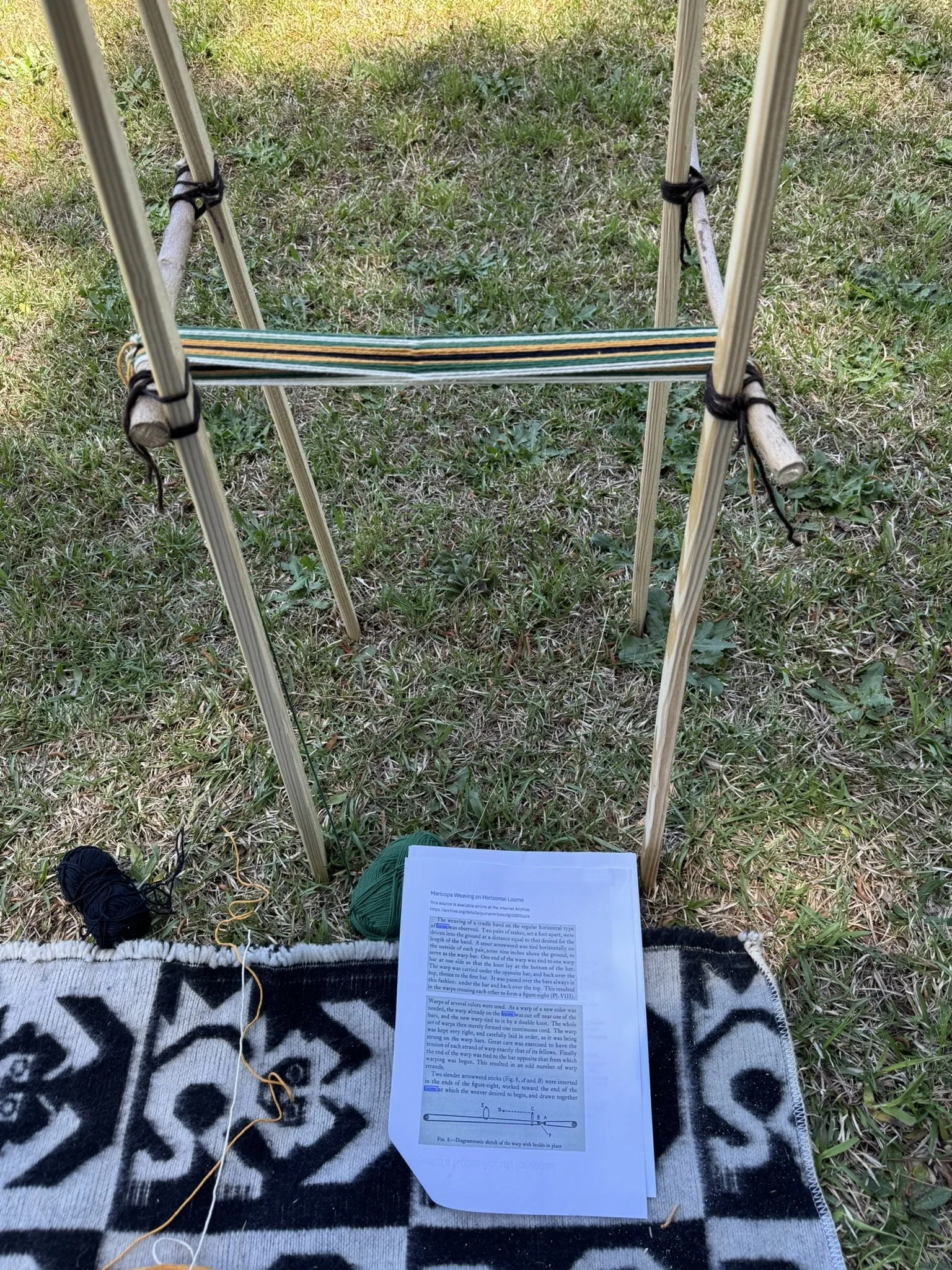
Horizontal Mesoamerican Loom
Originally written in April 2026.
Horizontal Looms
It turns out that Mistress Virag has the topic of horizontal looms pretty well covered: https://ladyvirag.wordpress.com/nomadic-looms-for-the-sca-simple-low-cost-historical-weaving/
Here’s some other info about horizontal looms, specifically found in Mesoamerica.
“Beginning about AD 700, and perhaps even earlier, with the introduction of cotton in to the Southwest and continuing through the nineteenth century, this type of loom was used variously by the Maricopa, Papago, Opata, and Pima tribes. It is thought that the horizontal loom spread northward from Mexico into this region long before the time of the Aztecs,” (Broudy, 44).
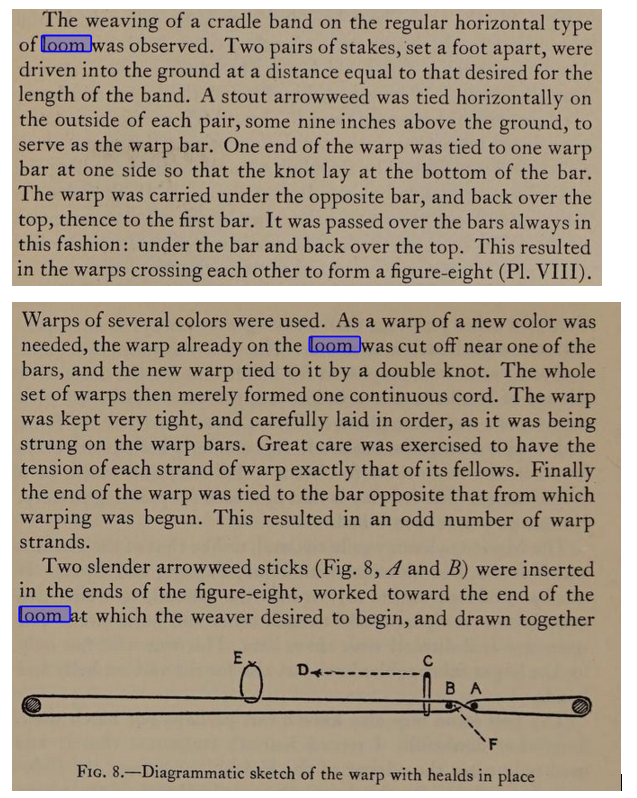
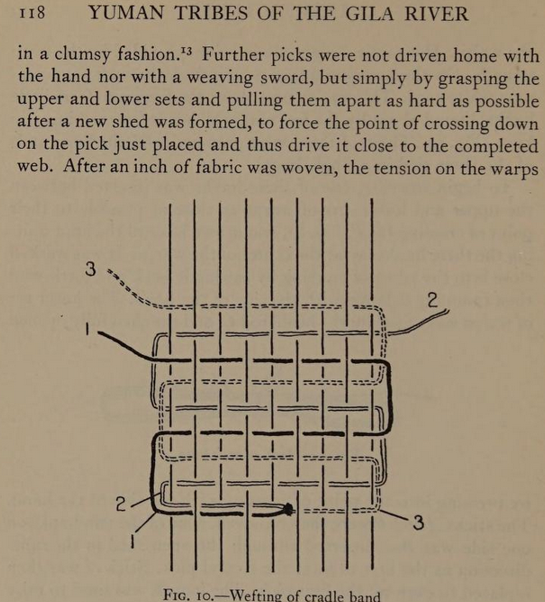
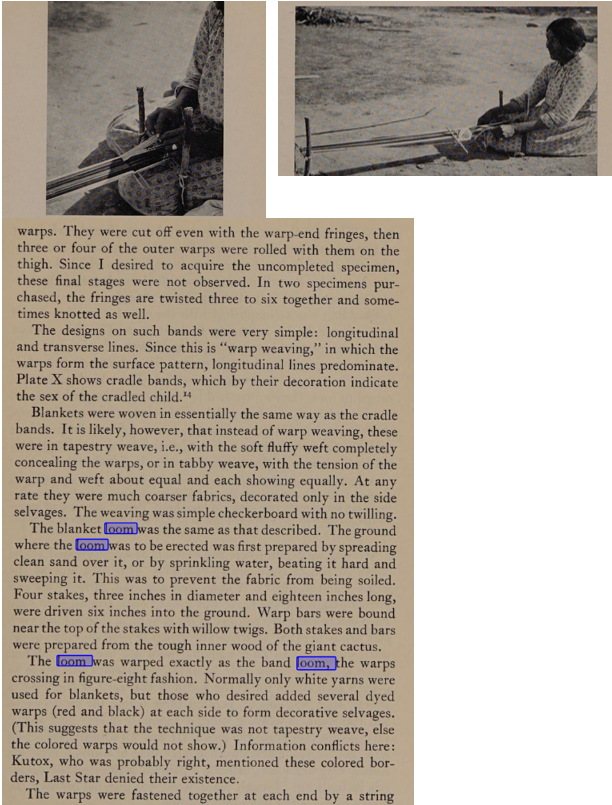
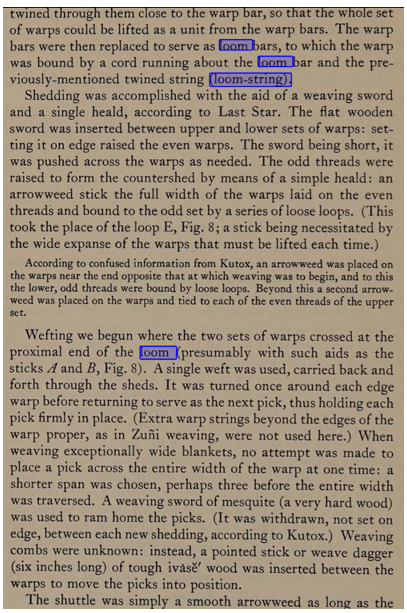
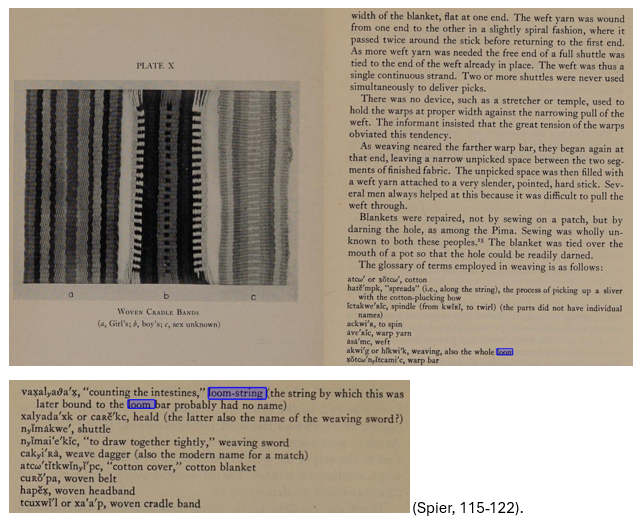
“The Maricopa loom was horizontal … identical with Pima, Papago, and Opata. It consisted of four stakes driven into the ground, to which new warp bars were tied, parallel to each other and horizontal. The warp was laid directly over these bars. This was used not only for the larger fabrics, blankets, but also for the various belts and bands. (Spier, 115).
Although weaving is frequently thought of as women’s work, men used ground looms in Mesoamerica (Broudy, 44). Men from the Pima-Papago also wove cloth (Beals, 27)
“The ground loom thrived best in wide-open spaces and where portability was at a premium – as with the Bedouin nomads. In such cases the loom required no further ‘improvements’” (Broudy, 44).
People around the Colorado River wore loincloths woven from willow bark on horizontal looms with a continuous warp. (Spier, 94).
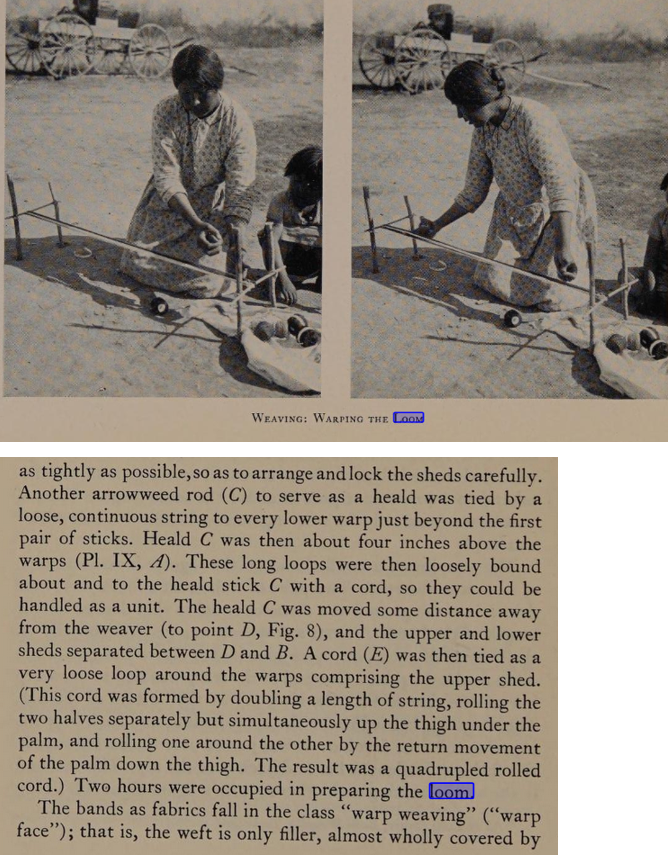
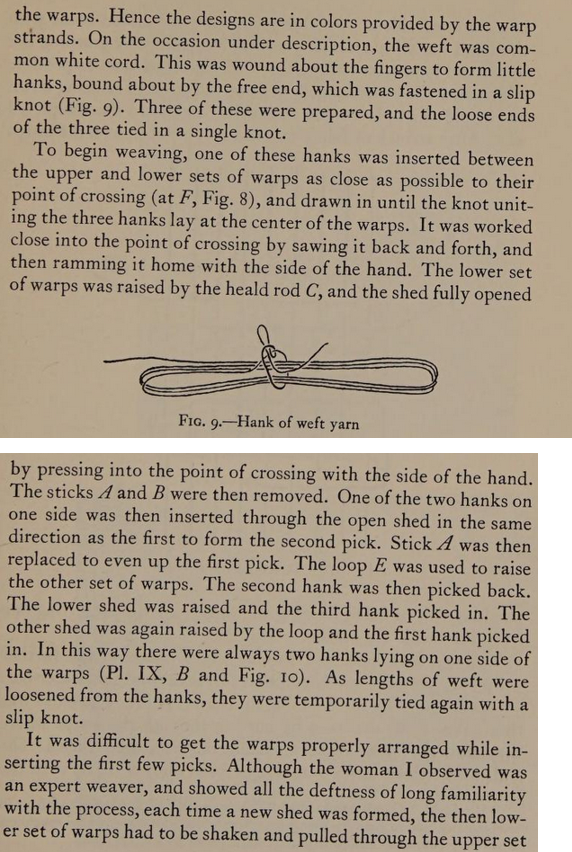
Maricopa Weaving on Horizontal Looms
This source is available online at the Internet Archive: https://archive.org/details/yumantribesofgil0000spie
Bibliography
Beals, Ralph L. Material Culture of the Pima, Papago, and Western Apache. Berkeley, California: Field Division of Education, 1934.
Broudy, Eric. The Book of Looms: A History of the Handloom from Ancient Times to the Present. Brandeis University Press, 1979.
Spier, Leslie. Yuman Tribes of the Gila River. Chicago: University of Chicago Press, 1933.
The loom I made at Spring Camp II
I never got very far with the actual weaving because I kept having to move it to keep me out of direct sunlight and the ground was as hard as concrete, so repeatedly driving the stakes into the ground got incredibly tiresome. I do plan to try again in a more favorable environment.